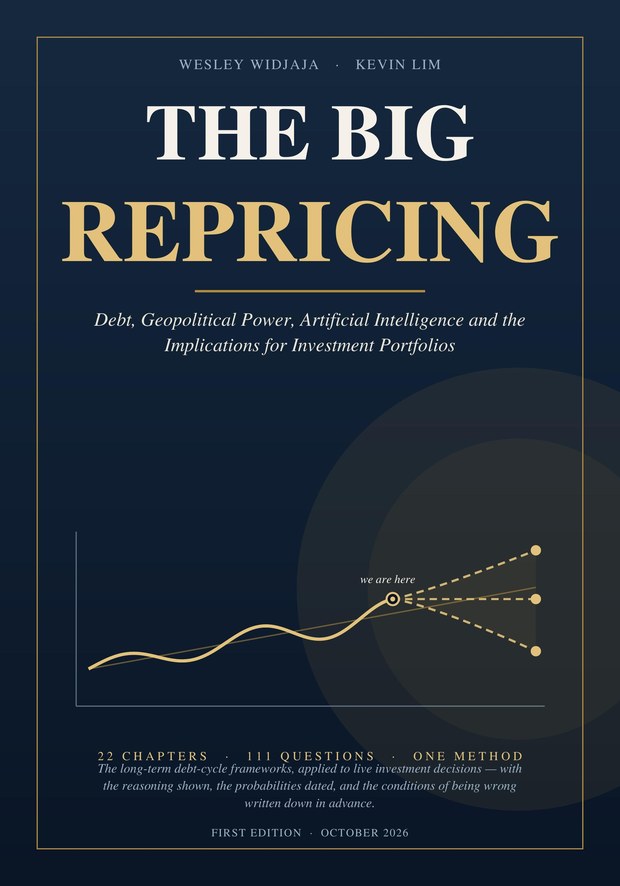
Everything has a price. All of it is about to be re-set.
The world’s debts have grown faster than the incomes that service them for two generations. The political order is straining, a technology large enough to bend the whole trajectory has arrived, and most institutions are positioned for the world of the last forty years rather than the one forming now.
The Big Repricing is a working manual for that transition. Built with attribution on the most influential account of the long-term debt cycle, it does what that account deliberately leaves to the reader: it turns the framework into decisions.
The book is arranged as one hundred and eleven questions — real questions, asked by people with money at risk, in committee rooms and margin notes and messages sent at inconvenient hours. Each one ends at a position.
Among the questions
- Where are we in the long debt cycle — and how would we know if we were wrong?
- Why are central banks quietly changing what they hold in reserve?
- Does artificial intelligence rescue the arithmetic, or accelerate it — and who is actually paying for the build-out?
- When the AI credit cycle turns, who eats the first loss — and why is it designed to land where almost nobody is looking?
- What does the US–China contest mean for the currency your wealth is measured in?
- What should an investor own, in what form, in which jurisdiction — and what, exactly, would change the answer?
The method is the point
Every major claim is chained to something observable that would disprove it. Every probability carries a date. The authors record where they changed their minds and why — because a forecast record is evidence about the forecaster.
A view held with named exit conditions is a position. The same view without them would be a mood.
Written for the professional investor who must defend positions, for the retail investor managing their own savings, for students of financial history, and for anyone who wants a fresh view of where the world is going. No prior reading is assumed: every framework is restated where it is used, and every term of art is defined at the back.
Start reading today
One chapter of the argument, run at full depth and free to share.
Book preview · October 2026
Who Carries the First Loss
How the AI build is financed, and what the lender actually owns
The public argument about AI infrastructure is an equity argument. The interesting risk is no longer there. The build is increasingly financed at one remove from the platform parents — through non-recourse vehicles, project-style campus financing and loans collateralised by the processors themselves — and the strongest balance sheets in the complex are the ones least attached to the marginal debt. This paper maps the stack, names what the lender actually owns, and states in advance what would prove the argument wrong.
Download the book preview (PDF)The authors
Wesley Widjaja
Portfolio Manager at Isola Capital, with twenty years in special-situations, event-driven and fundamental investing, previously leading the investment team at Ascapia Capital.
Kevin Lim
Fund Manager at Isola Capital, focused on multi-asset portfolios across equities, fixed income and alternatives.
Isola Capital is an asset-management and family-office platform with more than $2 billion in assets under advisory or management.
Contact
Requests, criticism and corrections reach the authors directly. Constructive criticism and information requests are welcome.
© 2026 Wesley Widjaja and Kevin Lim. The Big Repricing is published under Isola Capital. The book and the papers on this site are analysis for discussion and are not personalised investment, legal or tax advice; figures carry the dates of their sources and should be refreshed before any decision that depends on them. The work is built with attribution on published macro frameworks and is neither authored, reviewed nor endorsed by any of the authors cited within it.